Tuesday, 27 November 2012

Tessa Coleman, Artist of the Month, part 3


Seven Young Men in Venice

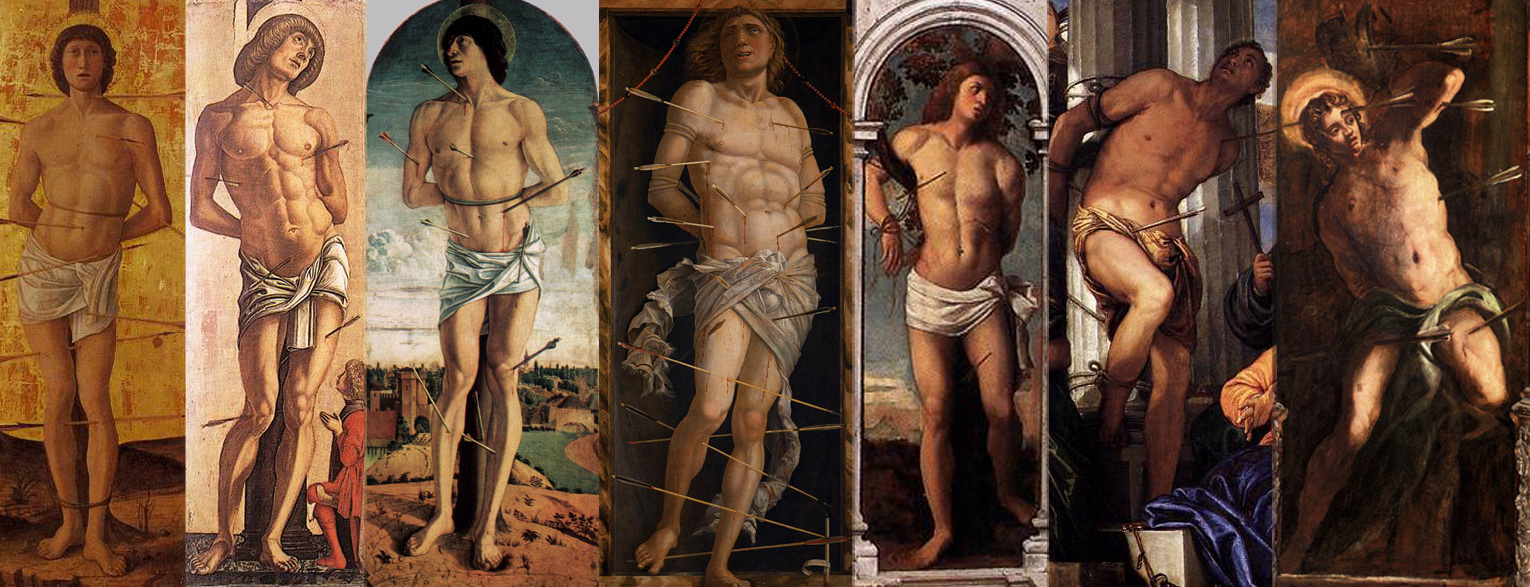
We took my in laws to Venice this week to celebrate my father in law’s eightieth birthday. The tourists had fled the floods and the rain and left Venice to the Venetians, most of whom were old and in furs so the city was quiet and slightly forlorn. I did come across seven beautiful young men as we meandered however, all called Sebastian and mostly Venetian, although one was passing through en route to Mantua. The line up tells one more about the development of the venetian renaissance than pages of writing can, have a look for yourself..


     Jacobo       Andrea da   Giovanni          Andrea           Palma         Veronese       Tintoretto
      Bellini        Murano        Bellini            Mantegna        Vecchio          1564               1587
      1464          1478              1468                   1506               1524       


A few things struck me about the gang of youths: firstly how Saint Sebastian packed on the pounds over the period. He starts looking positively skinny, is pretty perfect by the time Giovanni Bellini portrays him, but is building up the muscle, more Venice Beach than Venice, with Veronese and Tintoretto. To me the first three paintings are all about the drawing, but colour takes precedence in the final three. The pose also becomes progressively more dramatic, anguished and contorted, and by Tintoretto’s image poor old Sebastian is being skewered on the altar of mannerism.    

Lastly it struck me that, rather like Venice itself, what a close knit claustrophobic world venetian painting circles must have been. Jacobo was father to Giovanni and Gentile Bellini, father in law to Mantegna, who married Giovanni and Gentile’s sister Nicolosia, Giovanni taught Titian and Giorgione, Andrea da Murano imitated Giovanni, Titian briefly taught Tintoretto, Tintoretto and Veronese were arch rivals on  several big commissions, Palma Vecchio trained Boniface Veronese who trained Tintoretto after he fell out with Titian. I wish someone would make a painters tree out of the tangle of connections…  


Monday, 19 November 2012

Part 2. Tessa Coleman, Artist of the Month


Did Seurat ever meet Vermeer?

I was looking at a book of Seurat’s tonal drawings the other day and came across the wonderful drawing he did of his mother stitching her embroidery. The atmosphere of quiet concentration, the self containment, the beautiful subtlety and delicacy of the tonal values and the complete absence of line all reminded me forcibly of another much younger woman also hard at work with her stitching.

It turns out that the Lacemaker arrived in Paris to take up residence at her current home in the Louvre a few years before Seurat drew his mother in 1882. Piero Della Francesca is the name that more often springs to mind when looking at Seurat’s large paintings and he did spend time studying Piero as a student at the Ecole des Beaux Arts, but I feel sure he stood in front of the Vermeer’s Lacemaker now and again too.  


The Lacemaker                                                  
Vermeer 
(above)  


Seurat's Mother
Seurat (right)   


Both historic works of art are located at the Musee du Louvre
http://www.louvre.fr/  

 http://www.tessacoleman.co.uk/about.php                                                  


Monday, 5 November 2012

Artist of the Month November - Tessa Coleman


Enthusiastic Starts

As a painter I am insatiably curious about how fellow painters do their thing, how they work, how they avoid falling into the trap of practicing avoidance tactics, how they get down to the serious business of concentrating! So I thought I would start this blog by a quick tour of my studio and show you what is going on there at the moment.

Looking around I see with a sinking heart that it is littered with enthusiastic starts that have on the whole been abandoned for another more interesting idea once the going gets tough. There are always a few of these knocking about but they seem to have proliferated recently. There’s my current preoccupation with Piero Della Francesca’s Flagellation going on in one corner, to date two unfinished paintings, three books-worth of reading and still no sign of any resolution.


                                          stag head blocking in                                        


                                                          redrawing 

Then there’s the fine stag skull hanging precariously on a picture hook that I have been drawing for a while and thinking about painting for over a year. I finally made a start on it a couple of weeks ago, setting it up with two light sources and sets of shadows that make the most fantastic abstract patterns, and dived straight into the blocking in stages of the painting. It was a really good start as I had spent so much time drawing the skull I felt I knew where I was going with it. However I am now struggling to capture the terribly thin slice of tone that I have restricted myself to and to still the make the picture read coherently.                                   


                                                   but still too dark..

   
                                           getting there on the tones…  

In the corner by the window is a jar of forlorn dying flowers, vestiges of a painting that left for an exhibition recently in a bit of a hurry. I find it difficult sometimes to move the setup on even when the painting has long departed, because I know perfectly well the painting is not finished even though the deadline has well and truly passed! 

Leant against the wall is the most protracted enthusiastic start of all, a portrait of my daughter Oonagh lost in one of the first big novels she started to read aged nine. She is now fourteen, has grown ten inches,  no longer fits into the chair she was curled up in with that book five years ago, and I am still not happy with the painting. 

There are a few more starts lurking in the shadows that I am not going to ‘fess up to because I can’t even face them myself at the moment. Now I need to go make a cup of tea, eat a chocolate biscuit, and finish a few paintings….   

Thursday, 4 October 2012

Last call for artists to submit their work

We're getting ready for the open submission Friday 5th and Saturday 6th October. Good luck to all artists who would like their work to be hung at the annual New English Art Club exhibition. Want to know more? Check out the details on our website www.newenglishartclub.co.uk

If your work is accepted, it will be hung alongside the members work at the Mall Galleries from 30 November to 9 December.

Good luck!


Thursday, 13 September 2012

Charles Williams - Artist of the Month, July


13th July 2012


I am having a very busy July, even though it started with a holiday. My exhibition at Lilford Fine Art in Canterbury opens tonight, and we only got back from Hungary the day before yesterday. I made sure the whole thing was sorted out before we left, frames, mail-outs, facebook invitations and phone calls, though, so I have nothing to do but work out what to wear.

We go to Hungary a lot, because my brother-in-law lives in Budapest. Like a lot of Budapesters, he also has a cottage in the countryside, near Lake Balaton, and that’s where we stayed. It’s extraordinary countryside, with hills that are volcanic plugs and look like a child’s drawing of a hill, terraced and wooded, and Balaton is a seventy mile long freshwater lake, muddy and reeded, and lined with ‘Strands’, beaches that you pay to enter, with cafes, pedalos and shower blocks. You don’t pay much, and it’s a lovely, restful time.

I took the opportunity to get back into watercolour painting, partly because I have been commissioned to write a follow up to Basic Drawing on watercolour, and partly because I just want to muck around with watercolour. I have been looking at Patrick Proctor’s watercolours, and the easy-looking, ‘just-so’ quality that they have. Sometimes. Sometimes they’re pretty bad. As are mine.


Mina poses on the breakwater  w/c  10 x 8 cms

My niece and nephew, eight year old twins, pose for me when I offer them money. 20 Hungarian forints is worth about a penny, but they seem happy with it. I also draw more or less constantly in my sketchbook - the heat is so strong, and the activity so limited, just beach, swimming, sunbathing, that there is little else to do, so I enjoy looking and noting. I try to keep in mind Richard Pikesley’s advice, to find still lifes in the landscape, and Peter Brown’s, not to look too hard for a composition, and it seems to work, but the thing I really notice is that I could draw a person for hours but a landscape, from life, seems so confusing.


Landscape Study, Balaton, Hungary  w/c 8 x 12 cms

While I was there I thought a lot about the difference between photography and painting, and wonder why people like paintings of things and places, and why we paint things when we could photograph them. My answer is that painting and drawing gives you permission to stare at something for longer than photographing it does; the image you get at the end is a result of five minutes, an hour, a day, rather than a split second camera click, and so you notice more in the image and it seems to live in your memory longer. I have decided to write an article on this, as part of the series that Artist And Illustrator has asked from me. More writing.


My Mother-in-law in the shade

The other thing I want to write about is how we learn to draw. I read David Haycock’s ‘A Crisis Of Brilliance’ while I was in Hungary, an excellent book about early C20th painters from the Slade, Spencer, Carrington, Gertler, Nash, Nevinson - all artists who showed with the NEAC, by the way - and one of the main connections they had was that they’d all been taught to draw by Henry Tonks at the Slade.


Page of sketches, sketchbook

But what was it they were actually taught? My own definition of drawing is that it is how we represent form, independent of media. In other words, the term ‘drawing’ means, for me, not something done in pencil or charcoal, but how the form in a piece of work is described.
Perhaps Tonks’ chief influence is the clarity and integrity that you can see in the work of these five painters. Look at Gertler’s Merry-Go-Round, Spencer’s Centurion’s Servant or Carrington’s Lytton Strachey; one of the things they share, even though they are images extremely unlike one another, is that you are in no doubt about the physical forms represented.

Perhaps I’m talking rubbish. I am pretty good at that, as you will see if you tune in to BBC2 at 3pm on the 18th of this month, for Show Me The Monet, a TV programme about artists that combines Dragon’s Den with Britain’s Got Talent, in which I make an ass of myself. I kind of wish I hadn’t now.

16th July

The Private View was lovely, with ex-students, friends, collectors and artists all turning up. The gallery’s great, excellent wine served all evening and lots of amusing meetings, a few sales and general jolliness. To my great pleasure Sir Ronald Macintosh, one of the NEAC’s great patrons, who happens to live near Faversham, where I live, was there too.

My next task is to organise next year’s Drawing School curriculum and it’s no easy one. I have to schedule small runs of teaching, of perhaps two Saturdays next June, in July, and no one reallly wants to be committed like that. NEAC members tend to be busy working; a lot of them will be away in the summer months too, painting abroad, and impossible to get hold of. The RA Schools, where we hold many of our classes, are also on holiday, seemingly from June to September.

It is quite fun though, calling up my friends and bullying them into teaching - we catch up on news, share ideas and sometimes generate completely new courses. Mick Kirkbride, for example, has come up with the idea of running Beginner’s classes, away from the RA Schools, which might intimidate the more nervous student, and we’re starting that in a school in North London this September. We also run ‘Schools’ Saturdays’, where sixth-formers from various schools come to the RA Schools Life Room for a day of ‘old-fashioned observational drawing’. Most A-level students seem to think drawing is copying from photographs, and it’s sometimes a bit of a shock for them to be confronted with a live human being.


John Dobbs Townscape Study  Charcoal, pen and wash 2012

One of the best things about the Drawing School this year has been the Scholars; John Dobbs and Claire Robinson have been absolutely fantastic, highly committed and determined to get everything they can out of their year. It’s been a joy dealing with them, and they will be showing in the Open in November. I will be scheduling in a day to meet them and catch up with their work in the next week or two, if I can find some time between organising my Continuing Education classes at Christ Church Canterbury University, writing my Artist And Illustrator articles, writing my Basic Watercolour book, setting up the Mini-Art School we run at the Mall during the Open, putting my work in for the National Open Art Competition etc etc.

When do I do my own painting? You may well ask...


Swimmer at Balaton
Monday, 25 June 2012

Artist of the month - Richard Pikesley, Episode 3


Had a longish day painting in the studio.  
I was working on three bigger paintings derived from small studies painted on location around Weymouth Harbour.  I often work like this, some of the big paintings are started and finished on the spot but with much of the scaling up and building up the surface being completed back at the ranch.  It’s important to me that this process never becomes routine and I’ll try to alternate this sort of work with short bursts of direct observation  On Summer afternoons the light streams into the studio and my big easel gets pushed further and further back to keep the canvas out of direct sunlight.  I try to keep the process in the studio as much like painting on the spot as I can.  There’s an element of peril working in front of a subject, especially one that’s changing all the time and this helps to drive the eye to make decisions and keeps the panting energized.  Some come off and others don’t and those that don’t are kept as reminders to myself of a particular place and time.

By early evening the studio is like a goldfish bowl under a spotlight with the sun streaming down the length of the building.  
I’d noticed earlier that the little poppies that grow everywhere here were coming into flower so I quickly gather up some of their stems and start a little painting, placing them in the full blast of the evening sun.  This is just what I need and completes a busy day with a bit of excitement.


Poppies

Thursday, 21 June 2012

Artist of the Month - Richard Pikesley - Episode 2

Yesterday I painted in Weymouth through the afternoon and evening.  A bright day and plenty of boat traffic through the harbour.  I’m using a little box I can balance on my lap, a few tubes of oil colours and two or three brushes.  My walk from the car park takes me through the marina and with the sun low in the sky there is a glare of reflection on the rippled water with the rows of boats in a sort of half light.  The odd flags or banners ping out little points of colour amongst the reflections from the boat decks.  Although I know the effect will be short lived I’m working on a biggish board, 10 x 24, so I dive straight in and paint here for the first hour or so, knowing that if I don’t finish I can come back another day.  


Weymouth Harbour


The brilliant patch of reflected light moves further to the right as the sun drops a little and I realise I have to leave this spot and look for another subject.  The pins and needles hit as I attempt to stand up and I spend a minute or two hopping about until the cramp subsides.  I really don’t want to waste the good weather, the forecast says rain again tomorrow so I move quickly down the harbour.  There’s a gap with a view between the moored yachts and I squat here with my back against a bollard and have a look around.  ‘My’ side of the harbour is beginning to drop into shadow but the lifeboat, moored just across the water is still catching the sun so that’s the next subject on a little 8 x 10.  The character of the water is changing all the time, ruffled by the wind and disturbed by the wake of boats.


Weymouth Harbour 1


As more dinghies drift back into the harbour and they’re turning and tacking in front of me to get back to the slipway.  Lots of boats all on the move in and out of the light and I just can’t resist it.  Too much movement to do this very big so a little 5 x 12 board and paint very fast.  Although my main interest is in the boats I want to anchor the subject against the structure of the buildings behind.  It’s intoxicating stuff with all the movement and the richness of colour reflected in the water.  Always a challenge this is what I love doing best, trying to make paintings out of what’s unfolding in front of me.   Rain again tomorrow, ah well, there’s lots to do in the studio.   


Weymouth Harbour 2