Tuesday, 29 January 2013

Imagining the Sea by Louise Balaam


Imagining the sea

I’ve recently (like a lot of other people) found myself confined to the house, through a horrible and stubborn chest infection. I couldn’t get out to my studio and paint as I usually do, but as I started to feel better I felt like getting off the sofa and doing something. I’d been thinking about why I find the sea, and coasts, so fascinating. The ocean presents a barrier to our own travels (unless you have a boat or a ferry ticket!) but invites the eye to roam across it, and to imagine. I was interested in the idea of the mysterious hidden depths of the sea, and of the way the fluidity and rhythms of the sea seem to affect us all psychologically. Maybe it’s to do with the potentially immersive aspects, the way we imagine ourselves to be lost, and drowning in the depths.

I found a beautiful quote by Helen Chadwick : “…Looking at the sea … the specifics of personality wash away… Our state of consciousness takes us out of our body into rhythms that are fundamental and primary.” The iconic blue colour of the sea seems important for these aspects – a colour which is essentially ungraspable, always receding from us, implying depth and distance. I suddenly thought as well of the Chagall stained glass windows in the tiny church at Tudely in Kent, not far from here – the main window commemorates the drowning of a young woman, whose family commissioned the window. It’s worth seeking out if you’re nearby – it’s the only church in the world where all the windows are by Chagall. To me, there’s a real sense of the sea as a different space, with the lost girl in the depths – and is there a more resonant blue than stained glass?


I took out a range of water-based media – old watercolour sets, gouache, acrylic, pastel pencils, oil pastels – and some off-cuts of mountcard I’d found when turning things out a few days before. I spread everything on the floor and started some mixed media studies on the theme of the sea. I swooshed liquid blue watercolour washes onto the card, then worked into it with gouache and white acrylic, scribbling with graphite or pastel, or splashing more fluid paint onto it. Using a different medium from my usual oil paint means that the work changes – some things are possible in watercolour and gouache which wouldn’t work with oil, and perhaps some of the ideas about the fluidity and indefineable nature of water are naturally more suited to water-based media.  I don’t usually do studies in preparation for painting exactly, but I do feel that themes and motifs which emerge in studies find their way into paintings as well.

Sea Study 1
Sea Study 2
Sea Study 3
Sea Study 4


"Snow.." by Pete Brown


11:53pm, Sunday, 27th January 2013
“Snow..”
I love it!
It was going to snow all the previous night and all day on Friday 19th of January here in Bath and as we all know goddam everywhere!  It is such a transformational, transcient event that it simply can not be ignored and when it comes I can not get enough.  So that ‘eve of snow’ - the Thursday night - it was as close as it gets for me to the night before a major exam.  Replace sharpened pencils, the favourite ink pen, lucky gonk and last minute revision with a cleaned, feshly laid out palette, grounded boards and canvases of ALL sizes, a stock take of thermal layers, gloves, hats.. (with spares) and the gonk - my faded red cap.

Day one, as it was relentlessly snowing hard small icey crystals, was a complete write off and I returned home with 4 aborted attempts to soggy, cold, excited sledged out kids with stories of snowmen and collisions on the slopes, a grumpy dad.  I painted over the weekend and found myself more relaxed on the Sunday and when darkness fell took the little ones sledging on the pitch and put which overlooks Bath on the northern slopes.  It was fantastic but while I was there was taken by an amazing view of Bath I’d been told about by locals for the last 20 years which I had always dismissed and ridiculously or arrogantly never checked out. Well add a twilight extended by luminous lilac snow to it and I had a 20 x 40 painting in my head.  It was one of a few I worked on until this Friday just gone but the one that has stuck in my head.  I’d work on it early darkness/light in the mornings and late light/darkness at the end of the days.  Painting twilight involves mainly memory and anticipation and particularly trying not to do too much when it is dark!  The paintings are not yet photograghed.  Most of them need more work on architectural detail and drawing which I knew I could sort out on overcast days later on.

For now, here is a pic of my first day’s madness - the easel at the end of an attempt at early light on that Friday. The pallette is mainly snow, the turps is ice and the glaze medium - a slush puppy (the view incidentally is to left of shot):


The last day - snow had melted in Bath and I had to make a trip to Yeovil.  I drove through a winter wonderland and on the way back with a hour of light I was desperate to try and capture that amazing cold white and tried to paint a couple of fields of deep snow:


In Bath we don’t just knock up snowmen (no I did not do it - 3D and me do not mix well!):


I got very annoyed when I’d ask people how the snow was where they had come from.  They consistently got it wrong.  They’d say “Oh it’s really bad!” “You mean no snow””No tonnes of it””Well that’s GOOD not bad!”
I know it is dangerous for the elderly and for those who are self employed and are forced to look after the kids and lose work, it’s not great.  But particularly on those first two days I just met people who couldn’t stop smiling.

Monday, 31 December 2012

Charlotte Ardizzone by Pete Brown


I did not catch the email of 27th December from Richard Pikesley until yesterday and it’s devastating:
the sudden death of Charlotte Ardizzone.  

I don’t have the facility to wax eloquent about art  and I leave it to someone who can do her justice to talk about her life and work but I have always had great admiration for her paintings.  Charlotte had the ability to do what we all talk about.  To put down simply what is needed which she did with a brilliant confidence and yet sensitivity.  She had an understanding of the importance of space and her work had that fresh air in it that Sisley showed us.  She did not fuss but I think what made her such a great painter is that she did not show off.  She made beautiful brave paintings quietly.  I knew Charlotte only via committee meetings and critics’ lunches over the years and her direct manner in her painting was clearly an honest reflection of herself.  She said what she thought and how it was and I always found her wonderfully devoid of airs and graces and refreshing to talk to.  I loved the fact that she used to say ‘mate’ and enjoyed sneaking outside for a roll up.  The New English Art Club has suffered a great loss, that of  a brilliant talent and a wonderful character.  

Our thoughts are with Emily her daughter and all her family and friends.


Tuesday, 4 December 2012

Hanging the Annual Exhibition and the Opening by Tessa Coleman


 The New English Art Club Annual Exhibition hanging and opening

What a busy week for the NEAC! I’ll start at the end with a delightful opening ceremony at the private view that had the youngest member (bar one) Alex Fowler honouring the oldest member (bar none) Margaret Thomas. They both made splendid speeches and Margaret captured the sea of beaming faces with a very modern looking camera whilst making her speech.

Margaret is ninety five, she first exhibited with the New English in 1933 at the age of seventeen, was elected to membership in 1947 and has exhibited every year since. There is a tribute wall to her in this year’s exhibition with a selection of wonderful paintings spanning her long and successful painting life. Below is a painting from her wall together with a painting of the second youngest member Alex Fowler. There may be nearly sixty years separating them, but both painters clearly share the ethos of sensitive, thoughtful observational painting that is at the heart of the NEAC’s membership. They also look like they were having a great time together at the party.


                                             Kyffin Williams                   Books on a Table
                                            Margaret Thomas                 Alex Fowler


                                        Margaret’s Speech               At the party

The exhibition looks glorious, but it was a different story first thing Monday morning. I missed the hardest part of the decision making early in the morning, as my train was once again bogged down by floods in the west country. By the time I arrived the hanging committee and the hanging team had laid out 400 plus paintings on the main gallery floor and started to assemble them into hanging groups.

Larger contemporary works headed off to the new Threadneedle Space, smaller works went to the North Galleries, which left a mere few hundred (or so it seemed) to hang in the Main Gallery. How it was all hung by Tuesday is both a mystery and a miracle and I was there! I imagine the process of editing a national newspaper is similar: some journalists whisper, some shout, but they all want to be heard and are jostling for space against a scarily tight deadline. The editor in chief Richard Pikesley let all his journalists and subs have their say and the newspaper hit the presses on time.


                                                                    The hanging day


      Chief hanger                                                                     Hangers at work
      Richard Pikesley

It looks sensational. There are a lot of big ambitious works to see this year, and drawings and prints have been hung with paintings for the first time in a while to provide some interesting juxtapositions.

A wise painting friend once said to me that you that could always tell a great painter as they make you look at the world through their eyes and see things you would not otherwise see. As I left London early Friday morning after a great private view party, I suddenly spotted a pure Paul Newland painting come to life. It was there in the glimpse of a fairground and ferris wheel through the trees in the pale morning light across the frosted green grass of Hyde Park, bright lozenges of colour against pearly grey morning light, with silverpoint sharp drawing.

Here is another of Paul’s paintings that is in the exhibition. Come and see this and many other very individual visions of our world for yourselves throughout  this week at the Mall Galleries.

   
                                             That time of Year
                                             Paul Newland


Tuesday, 27 November 2012

Tessa Coleman, Artist of the Month, part 3


Seven Young Men in Venice

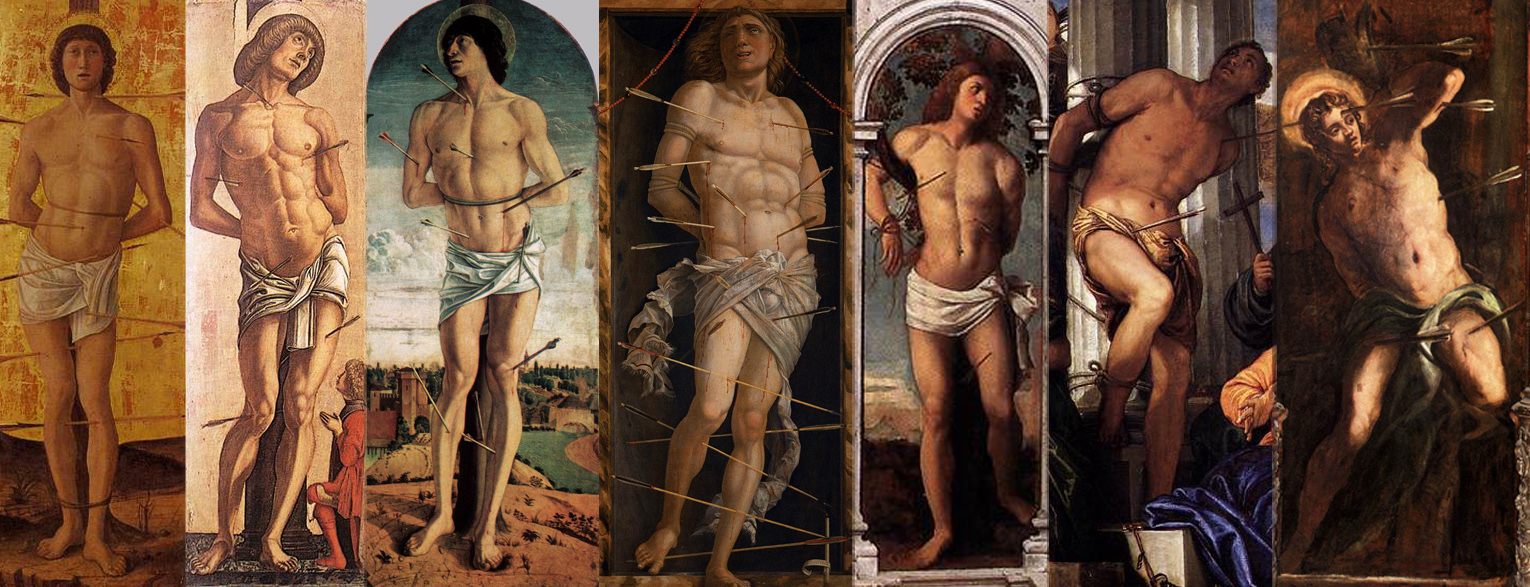
We took my in laws to Venice this week to celebrate my father in law’s eightieth birthday. The tourists had fled the floods and the rain and left Venice to the Venetians, most of whom were old and in furs so the city was quiet and slightly forlorn. I did come across seven beautiful young men as we meandered however, all called Sebastian and mostly Venetian, although one was passing through en route to Mantua. The line up tells one more about the development of the venetian renaissance than pages of writing can, have a look for yourself..


     Jacobo       Andrea da   Giovanni          Andrea           Palma         Veronese       Tintoretto
      Bellini        Murano        Bellini            Mantegna        Vecchio          1564               1587
      1464          1478              1468                   1506               1524       


A few things struck me about the gang of youths: firstly how Saint Sebastian packed on the pounds over the period. He starts looking positively skinny, is pretty perfect by the time Giovanni Bellini portrays him, but is building up the muscle, more Venice Beach than Venice, with Veronese and Tintoretto. To me the first three paintings are all about the drawing, but colour takes precedence in the final three. The pose also becomes progressively more dramatic, anguished and contorted, and by Tintoretto’s image poor old Sebastian is being skewered on the altar of mannerism.    

Lastly it struck me that, rather like Venice itself, what a close knit claustrophobic world venetian painting circles must have been. Jacobo was father to Giovanni and Gentile Bellini, father in law to Mantegna, who married Giovanni and Gentile’s sister Nicolosia, Giovanni taught Titian and Giorgione, Andrea da Murano imitated Giovanni, Titian briefly taught Tintoretto, Tintoretto and Veronese were arch rivals on  several big commissions, Palma Vecchio trained Boniface Veronese who trained Tintoretto after he fell out with Titian. I wish someone would make a painters tree out of the tangle of connections…  


Monday, 19 November 2012

Part 2. Tessa Coleman, Artist of the Month


Did Seurat ever meet Vermeer?

I was looking at a book of Seurat’s tonal drawings the other day and came across the wonderful drawing he did of his mother stitching her embroidery. The atmosphere of quiet concentration, the self containment, the beautiful subtlety and delicacy of the tonal values and the complete absence of line all reminded me forcibly of another much younger woman also hard at work with her stitching.

It turns out that the Lacemaker arrived in Paris to take up residence at her current home in the Louvre a few years before Seurat drew his mother in 1882. Piero Della Francesca is the name that more often springs to mind when looking at Seurat’s large paintings and he did spend time studying Piero as a student at the Ecole des Beaux Arts, but I feel sure he stood in front of the Vermeer’s Lacemaker now and again too.  


The Lacemaker                                                  
Vermeer 
(above)  


Seurat's Mother
Seurat (right)   


Both historic works of art are located at the Musee du Louvre
http://www.louvre.fr/  

 http://www.tessacoleman.co.uk/about.php                                                  


Monday, 5 November 2012

Artist of the Month November - Tessa Coleman


Enthusiastic Starts

As a painter I am insatiably curious about how fellow painters do their thing, how they work, how they avoid falling into the trap of practicing avoidance tactics, how they get down to the serious business of concentrating! So I thought I would start this blog by a quick tour of my studio and show you what is going on there at the moment.

Looking around I see with a sinking heart that it is littered with enthusiastic starts that have on the whole been abandoned for another more interesting idea once the going gets tough. There are always a few of these knocking about but they seem to have proliferated recently. There’s my current preoccupation with Piero Della Francesca’s Flagellation going on in one corner, to date two unfinished paintings, three books-worth of reading and still no sign of any resolution.


                                          stag head blocking in                                        


                                                          redrawing 

Then there’s the fine stag skull hanging precariously on a picture hook that I have been drawing for a while and thinking about painting for over a year. I finally made a start on it a couple of weeks ago, setting it up with two light sources and sets of shadows that make the most fantastic abstract patterns, and dived straight into the blocking in stages of the painting. It was a really good start as I had spent so much time drawing the skull I felt I knew where I was going with it. However I am now struggling to capture the terribly thin slice of tone that I have restricted myself to and to still the make the picture read coherently.                                   


                                                   but still too dark..

   
                                           getting there on the tones…  

In the corner by the window is a jar of forlorn dying flowers, vestiges of a painting that left for an exhibition recently in a bit of a hurry. I find it difficult sometimes to move the setup on even when the painting has long departed, because I know perfectly well the painting is not finished even though the deadline has well and truly passed! 

Leant against the wall is the most protracted enthusiastic start of all, a portrait of my daughter Oonagh lost in one of the first big novels she started to read aged nine. She is now fourteen, has grown ten inches,  no longer fits into the chair she was curled up in with that book five years ago, and I am still not happy with the painting. 

There are a few more starts lurking in the shadows that I am not going to ‘fess up to because I can’t even face them myself at the moment. Now I need to go make a cup of tea, eat a chocolate biscuit, and finish a few paintings….   

Thursday, 4 October 2012

Last call for artists to submit their work

We're getting ready for the open submission Friday 5th and Saturday 6th October. Good luck to all artists who would like their work to be hung at the annual New English Art Club exhibition. Want to know more? Check out the details on our website www.newenglishartclub.co.uk

If your work is accepted, it will be hung alongside the members work at the Mall Galleries from 30 November to 9 December.

Good luck!


Thursday, 13 September 2012

Charles Williams - Artist of the Month, July


13th July 2012


I am having a very busy July, even though it started with a holiday. My exhibition at Lilford Fine Art in Canterbury opens tonight, and we only got back from Hungary the day before yesterday. I made sure the whole thing was sorted out before we left, frames, mail-outs, facebook invitations and phone calls, though, so I have nothing to do but work out what to wear.

We go to Hungary a lot, because my brother-in-law lives in Budapest. Like a lot of Budapesters, he also has a cottage in the countryside, near Lake Balaton, and that’s where we stayed. It’s extraordinary countryside, with hills that are volcanic plugs and look like a child’s drawing of a hill, terraced and wooded, and Balaton is a seventy mile long freshwater lake, muddy and reeded, and lined with ‘Strands’, beaches that you pay to enter, with cafes, pedalos and shower blocks. You don’t pay much, and it’s a lovely, restful time.

I took the opportunity to get back into watercolour painting, partly because I have been commissioned to write a follow up to Basic Drawing on watercolour, and partly because I just want to muck around with watercolour. I have been looking at Patrick Proctor’s watercolours, and the easy-looking, ‘just-so’ quality that they have. Sometimes. Sometimes they’re pretty bad. As are mine.


Mina poses on the breakwater  w/c  10 x 8 cms

My niece and nephew, eight year old twins, pose for me when I offer them money. 20 Hungarian forints is worth about a penny, but they seem happy with it. I also draw more or less constantly in my sketchbook - the heat is so strong, and the activity so limited, just beach, swimming, sunbathing, that there is little else to do, so I enjoy looking and noting. I try to keep in mind Richard Pikesley’s advice, to find still lifes in the landscape, and Peter Brown’s, not to look too hard for a composition, and it seems to work, but the thing I really notice is that I could draw a person for hours but a landscape, from life, seems so confusing.


Landscape Study, Balaton, Hungary  w/c 8 x 12 cms

While I was there I thought a lot about the difference between photography and painting, and wonder why people like paintings of things and places, and why we paint things when we could photograph them. My answer is that painting and drawing gives you permission to stare at something for longer than photographing it does; the image you get at the end is a result of five minutes, an hour, a day, rather than a split second camera click, and so you notice more in the image and it seems to live in your memory longer. I have decided to write an article on this, as part of the series that Artist And Illustrator has asked from me. More writing.


My Mother-in-law in the shade

The other thing I want to write about is how we learn to draw. I read David Haycock’s ‘A Crisis Of Brilliance’ while I was in Hungary, an excellent book about early C20th painters from the Slade, Spencer, Carrington, Gertler, Nash, Nevinson - all artists who showed with the NEAC, by the way - and one of the main connections they had was that they’d all been taught to draw by Henry Tonks at the Slade.


Page of sketches, sketchbook

But what was it they were actually taught? My own definition of drawing is that it is how we represent form, independent of media. In other words, the term ‘drawing’ means, for me, not something done in pencil or charcoal, but how the form in a piece of work is described.
Perhaps Tonks’ chief influence is the clarity and integrity that you can see in the work of these five painters. Look at Gertler’s Merry-Go-Round, Spencer’s Centurion’s Servant or Carrington’s Lytton Strachey; one of the things they share, even though they are images extremely unlike one another, is that you are in no doubt about the physical forms represented.

Perhaps I’m talking rubbish. I am pretty good at that, as you will see if you tune in to BBC2 at 3pm on the 18th of this month, for Show Me The Monet, a TV programme about artists that combines Dragon’s Den with Britain’s Got Talent, in which I make an ass of myself. I kind of wish I hadn’t now.

16th July

The Private View was lovely, with ex-students, friends, collectors and artists all turning up. The gallery’s great, excellent wine served all evening and lots of amusing meetings, a few sales and general jolliness. To my great pleasure Sir Ronald Macintosh, one of the NEAC’s great patrons, who happens to live near Faversham, where I live, was there too.

My next task is to organise next year’s Drawing School curriculum and it’s no easy one. I have to schedule small runs of teaching, of perhaps two Saturdays next June, in July, and no one reallly wants to be committed like that. NEAC members tend to be busy working; a lot of them will be away in the summer months too, painting abroad, and impossible to get hold of. The RA Schools, where we hold many of our classes, are also on holiday, seemingly from June to September.

It is quite fun though, calling up my friends and bullying them into teaching - we catch up on news, share ideas and sometimes generate completely new courses. Mick Kirkbride, for example, has come up with the idea of running Beginner’s classes, away from the RA Schools, which might intimidate the more nervous student, and we’re starting that in a school in North London this September. We also run ‘Schools’ Saturdays’, where sixth-formers from various schools come to the RA Schools Life Room for a day of ‘old-fashioned observational drawing’. Most A-level students seem to think drawing is copying from photographs, and it’s sometimes a bit of a shock for them to be confronted with a live human being.


John Dobbs Townscape Study  Charcoal, pen and wash 2012

One of the best things about the Drawing School this year has been the Scholars; John Dobbs and Claire Robinson have been absolutely fantastic, highly committed and determined to get everything they can out of their year. It’s been a joy dealing with them, and they will be showing in the Open in November. I will be scheduling in a day to meet them and catch up with their work in the next week or two, if I can find some time between organising my Continuing Education classes at Christ Church Canterbury University, writing my Artist And Illustrator articles, writing my Basic Watercolour book, setting up the Mini-Art School we run at the Mall during the Open, putting my work in for the National Open Art Competition etc etc.

When do I do my own painting? You may well ask...


Swimmer at Balaton

Monday, 25 June 2012

Artist of the month - Richard Pikesley, Episode 3


Had a longish day painting in the studio.  
I was working on three bigger paintings derived from small studies painted on location around Weymouth Harbour.  I often work like this, some of the big paintings are started and finished on the spot but with much of the scaling up and building up the surface being completed back at the ranch.  It’s important to me that this process never becomes routine and I’ll try to alternate this sort of work with short bursts of direct observation  On Summer afternoons the light streams into the studio and my big easel gets pushed further and further back to keep the canvas out of direct sunlight.  I try to keep the process in the studio as much like painting on the spot as I can.  There’s an element of peril working in front of a subject, especially one that’s changing all the time and this helps to drive the eye to make decisions and keeps the panting energized.  Some come off and others don’t and those that don’t are kept as reminders to myself of a particular place and time.

By early evening the studio is like a goldfish bowl under a spotlight with the sun streaming down the length of the building.  
I’d noticed earlier that the little poppies that grow everywhere here were coming into flower so I quickly gather up some of their stems and start a little painting, placing them in the full blast of the evening sun.  This is just what I need and completes a busy day with a bit of excitement.


Poppies